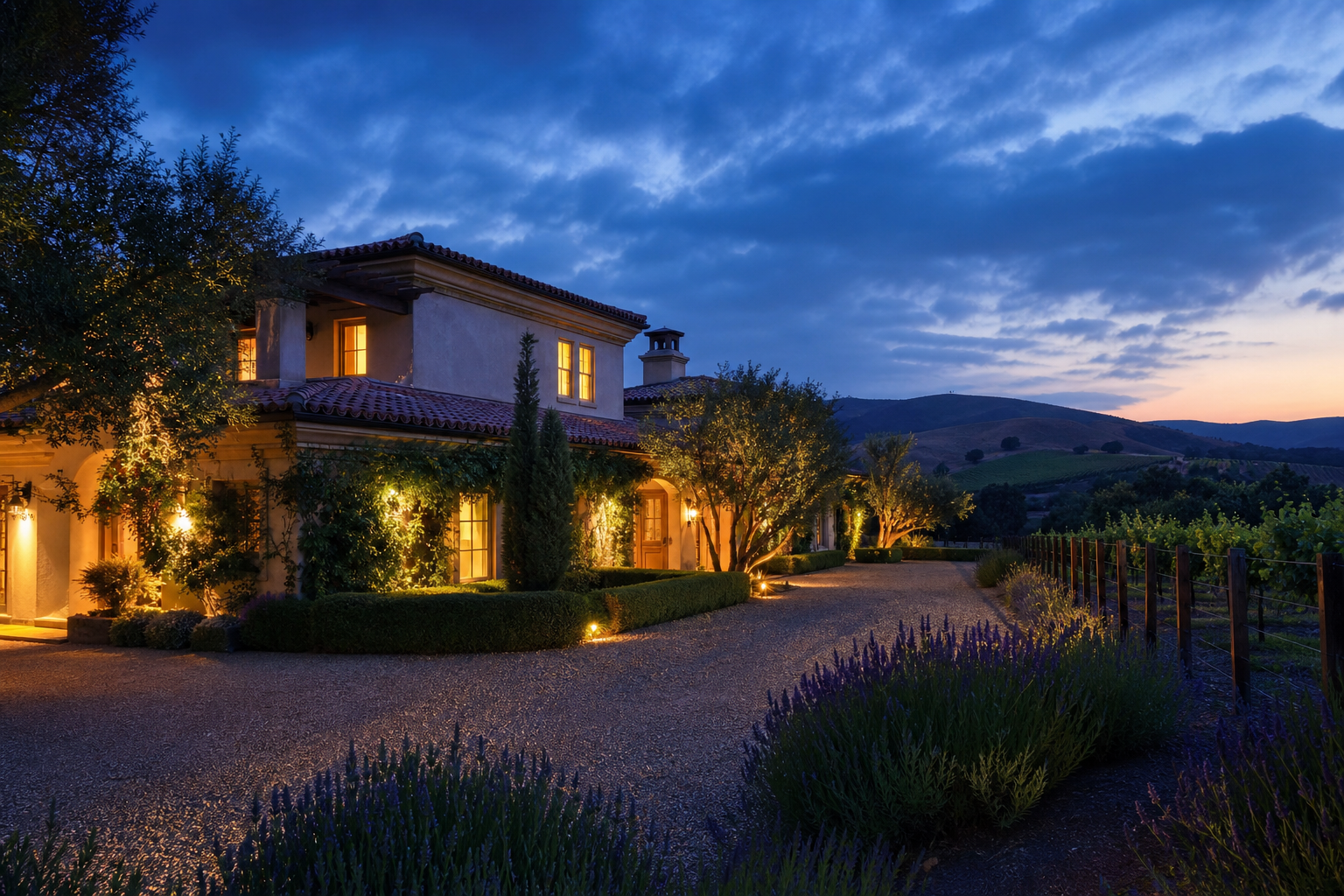
Santa Ynez Valley offers a rare combination of wine-country living, luxury property diversity, and a mild Central Coast climate. With seven distinct AVAs, 60-plus grape varietals, and a real estate market anchored by strong demand, it’s one of California’s most compelling wine-country addresses for buyers seeking more than a weekend retreat.
What is the vineyard lifestyle really like in Santa Ynez Valley real estate?
Santa Ynez Valley is one of California’s most distinctive wine-country addresses, where daily life revolves around open ranchland, tasting rooms, and a mild Mediterranean climate. Buyers here aren’t just purchasing a home, they’re buying into an entire lifestyle defined by seven American Viticultural Areas (AVAs), 60-plus grape varietals, and a pace of life that’s hard to replicate anywhere else on the Central Coast.
Key Takeaways
- Recent local market data shows a median sale price of $1,545,000 in Solvang (median 39 days on market), making it one of the higher-priced communities in the valley as of September 2026.
- Santa Ynez Valley spans seven distinct AVAs, with over 60 grape varietals grown across the region, the most AVA diversity of any single valley in California.
- Property types range from vineyard estates and equestrian ranches to contemporary homes with vineyard views, giving buyers multiple entry points into wine-country living.
- Nearby Buellton shows a median sale price of $890,000 with a median 58 days on market, offering a more accessible price point within commuting distance of the valley’s core wine corridor.
- Buyers considering a working vineyard or hobby wine label can find properties with existing vine acreage, though operating a small label involves additional licensing and agricultural planning steps worth discussing with local advisors.
What does day-to-day life look like when you live in Santa Ynez Valley wine country?
Full-time residents will tell you the valley feels different from the inside. Weekend visitors see the tasting rooms and the golden hills. Residents see the fog rolling through Sta. Rita Hills on a Tuesday morning, the quiet of a weekday afternoon in Los Olivos, and the rhythm of harvest season in the fall.
The towns themselves each carry a distinct character. Solvang brings a walkable, village-scale energy with Danish architecture and a strong tasting-room corridor. Santa Ynez and Los Olivos lean more toward ranch and equestrian living, with larger parcels and a quieter pace. Buellton sits at the western gateway to the valley and offers more approachable price points while keeping you close to the wine corridor and the US-101 connection to Santa Barbara and the coast.
Tourism does pick up during peak seasons, particularly in summer and around harvest. That’s part of the tradeoff residents accept, and most embrace it. The valley’s reputation as a destination keeps local restaurants, tasting rooms, and small businesses thriving in ways that purely residential communities can’t match. Your neighbors are winemakers, ranchers, artists, and people who commuted from Los Angeles or Santa Barbara and decided to stop commuting.
How close are homes to wineries and tasting rooms?
Proximity varies by location, but in many parts of the valley you’re genuinely a short drive, sometimes a short bike ride, from multiple tasting rooms. The seven AVAs that make up the Santa Ynez Valley wine region are spread across a relatively compact geographic area, so even if you’re based in Buellton, you’re within 20 minutes of producers in Sta. Rita Hills, Ballard Canyon, and the Santa Ynez Valley AVA proper. Buyers who want to walk or bike to a tasting room will find the best options in and around the Los Olivos village core, where several tasting rooms cluster within a few blocks of each other.
What is the climate like for year-round living?
The valley runs on a Mediterranean pattern: warm, dry summers with cool mornings, and mild winters with most of the annual rainfall concentrated between November and March. The marine influence from the Pacific moderates temperatures more than you’d expect this far inland. Sta. Rita Hills, the westernmost AVA, gets notably more fog and wind, which is exactly why it produces some of California’s finest cool-climate pinot noir and chardonnay. The eastern sub-regions, including Happy Canyon of Santa Barbara, run warmer and drier, supporting Bordeaux varieties like cabernet sauvignon and sauvignon blanc. As a resident, that climate diversity means you can choose your microclimate based on how you want to live, and which wines you want growing in your backyard.
What does the Santa Ynez Valley luxury real estate market look like in 2026?
The market here is genuinely varied, and that’s what makes it interesting for buyers at different stages. You’re not looking at a single price band, the valley spans everything from move-in-ready homes in Buellton and Solvang to multi-acre vineyard estates and working equestrian ranches with significant land.
Recent local market data across the valley reflects that range. Solvang, with its walkable village core and strong tourism infrastructure, is currently the highest-priced community in the data set. Buellton, at the valley’s western edge, offers a more accessible entry point while keeping buyers within easy reach of the wine corridor and the US-101 commute corridor to Santa Barbara and Vandenberg Space Force Base.
Here’s a current snapshot of area-level medians as of September 2026, based on recent aggregated public listing data (trailing approximately 90 days). Individual home values vary by condition, parcel size, vintage, and specific location within each area.
| Area | Median Sale Price | Median Days on Market |
|---|---|---|
| Solvang | $1,545,000 | 39 |
| Guadalupe | $635,000 | 49 |
| Lompoc | $610,000 | 44 |
Buellton’s recent local market data shows a median sale price of $890,000 with a median of 58 days on market, reflecting the more measured pace of a market where buyers are making considered, long-term decisions rather than competing in a sprint. With only five new listings in the last 30 days and 15 homes sold in the trailing 90-day window, inventory is limited. That’s a consistent pattern we see across the valley: demand holds steady, but supply stays tight, especially at the upper end.
How does Santa Ynez Valley compare to Napa or Sonoma?
The honest answer is that Santa Ynez Valley offers comparable lifestyle quality at a meaningfully different price point than the most established Napa Valley addresses, and with a character that’s distinctly its own. You’re not getting the same brand recognition as a Napa postal address, but you are getting what observers are calling California’s most unique wine region, one with genuine AVA diversity, a less crowded tasting-room circuit, and a real-estate market that hasn’t yet priced out buyers the way the Napa floor has. For buyers who want wine-country living without the Napa premium, the Santa Ynez Valley is worth a serious look. We walk our clients through this comparison regularly, and the lifestyle value here is hard to argue with.
Is buying a working vineyard or hobby wine label realistic here?
Yes, it’s realistic, and it’s one of the more unique aspects of this market. Properties with existing vine acreage do come to market, ranging from small hobby plantings of a few acres to larger estates with established varietals already in the ground. Operating a bonded winery or producing wine commercially requires federal and state licensing through the California Department of Alcoholic Beverage Control and the TTB, so if your goal is to produce and sell wine under your own label, you’ll want to work through that process with an agricultural attorney and a vineyard consultant early. A hobby vineyard, growing grapes for personal use or to sell to an established producer, is a more straightforward path. The valley has a deep network of viticulture consultants and custom-crush facilities that make small-scale production genuinely accessible. Your specific situation depends on the property, the existing plantings, water rights, and your goals, that’s a conversation worth having before you make an offer.
How does living here connect to jobs and commuting?
The valley isn’t isolated. US-101 connects Buellton and Solvang to Santa Barbara in roughly 45 minutes under normal conditions, and to Vandenberg Space Force Base in about 20-25 minutes from the western end of the valley. For military families stationed at Vandenberg, the Santa Ynez Valley is a realistic daily commute, and one that trades the base-adjacent housing options for open land, wine-country views, and a genuinely different quality of life. We work with a number of military families making exactly this calculation, and understanding the commute timing relative to gate access and shift schedules is part of how we help them think through the tradeoff. The National Association of REALTORS® consistently finds that commute tolerance is one of the top factors buyers reconsider after moving to a lifestyle-driven market, and most who land in the valley say it was worth it.
For buyers whose work is remote or flexible, the commute question largely disappears, and the valley’s combination of high-speed internet infrastructure, open space, and community character becomes the entire value proposition.
Every situation is different, and the only way to know whether a specific property, location, or lifestyle configuration works for your life is to run through it with someone who knows this market deeply. That’s exactly what we do.
Frequently Asked Questions
What kinds of luxury properties are available in Santa Ynez Valley?
Santa Ynez Valley offers one of the most diverse luxury property menus on the California Central Coast, including vineyard estates with planted acreage, equestrian ranches with riding facilities and barn infrastructure, contemporary homes with panoramic vineyard or mountain views, and village-adjacent properties within walking distance of tasting rooms. The range in parcel size is significant, from under an acre in Solvang’s village core to hundreds of acres on working ranch properties, so buyers can match their lifestyle priorities to a specific property type rather than settling for a single format.
How busy does the valley get during peak tourism season, and how does that affect residents?
Tourism peaks during summer weekends and the fall harvest season, when tasting rooms, restaurants, and the Los Olivos village see the most visitor traffic. For residents, this generally means heavier weekend traffic on Highway 154 and in the village cores, but weekday life remains comparatively quiet. Most full-time residents view the tourism infrastructure as a net positive, it sustains the restaurants, tasting rooms, and local businesses that make the valley worth living in year-round. Buyers who prioritize privacy tend to gravitate toward properties set back from the main corridors, where the tourism pulse is easy to tune out.
How does the Santa Ynez Valley market compare to Napa or Sonoma in price and lifestyle?
Santa Ynez Valley generally offers wine-country lifestyle at a lower price floor than the most established Napa Valley addresses, while delivering comparable AVA diversity and arguably more intimate tasting-room access. The valley’s seven AVAs and 60-plus grape varietals, as documented in early 2026, give it a wine profile that serious collectors and producers find genuinely compelling. The lifestyle is less formal than Napa, more ranch-and-outdoors in character, and the real estate market still has room that Napa’s floor no longer offers. That said, the upper end of the Santa Ynez market, large estate properties with established vineyards, competes on a national luxury stage.
Is it possible to commute from Santa Ynez Valley to Vandenberg Space Force Base or Santa Barbara?
Yes, both commutes are realistic depending on where in the valley you’re based. From Buellton, Vandenberg Space Force Base is approximately 20-25 minutes via US-101, and Santa Barbara is roughly 45 minutes under normal conditions. Buyers stationed at Vandenberg who want wine-country living rather than base-adjacent housing often find the western end of the valley, Buellton in particular, hits the right balance between commute length and lifestyle. We help military families think through this tradeoff regularly, including how base gate access and shift timing interact with the drive.
What should I know before buying a property with existing vineyard acreage?
Buying a property with planted vines adds a layer of due diligence beyond a standard home purchase. You’ll want to understand the varietal, vine age, irrigation infrastructure, and any existing farming contracts with outside producers. Water rights are a critical factor in this region and vary significantly by property. If you intend to produce and sell wine commercially, federal and state licensing through the California ABC and the TTB is required before you can sell a bottle. For a hobby vineyard, the process is simpler, but the agricultural management questions remain. We always recommend buyers bring a vineyard consultant into the inspection process when vine acreage is part of the purchase.
The Bottom Line on Santa Ynez Valley Wine-Country Living
Santa Ynez Valley is one of the few places in California where you can wake up surrounded by working vineyards, drive to a world-class tasting room in ten minutes, and still reach Santa Barbara or Vandenberg Space Force Base for work. The real estate market reflects genuine demand for that combination, and inventory stays tight enough that the right properties don’t wait around.
If you’re serious about exploring wine-country living in the Santa Ynez Valley, we’d love to walk you through what’s available and what fits your life. Reach out to start your Central Coast home search, or if you already own in the valley and want to understand what your property is worth in today’s market, request a free home equity review. We’re here when you’re ready.
You can also browse our neighborhood news and local market updates for the latest on Santa Ynez Valley and the broader Central Coast.
Coldwell Banker Select Realty fully supports the principles of the Fair Housing Act and the Equal Opportunity Act. Tammy Atkin, CA License. Regulated by the California Department of Real Estate. This article is general information only and does not constitute legal, tax, or financial advice, confirm your specific numbers and circumstances with your closing agent, tax advisor, or lender.